Research
AI for protein dynamics, RNA, membranes, interactions, and evolution.
Our research investigates how proteins and RNA are built, how they move, how they interact, how they evolve, and how to model these processes using modern computational methods. We work at the interface of bioinformatics, machine learning, structural biology, and evolutionary analysis, with a strong focus on method development that enables new biological insight.
Protein dynamics and conformational change
Structure prediction has largely solved the problem of producing a single static model, but biology happens through motion. Enzymes open and close, transporters alternate between inward- and outward-facing states, and binding sites form transiently. We develop machine-learning methods that predict how a protein moves directly from its structure, rather than by running the molecular dynamics simulations that would otherwise be required. Our BackFlip models use SE(3)-equivariant networks to predict per-residue fluctuations and the pairwise couplings between residues, recovering the correlated, long-range motions that simpler elastic-network baselines miss, at a fraction of the cost of simulation. Because the predictions are fast enough to run across entire proteomes, they turn dynamics from something measured one protein at a time into something that can be surveyed at scale.
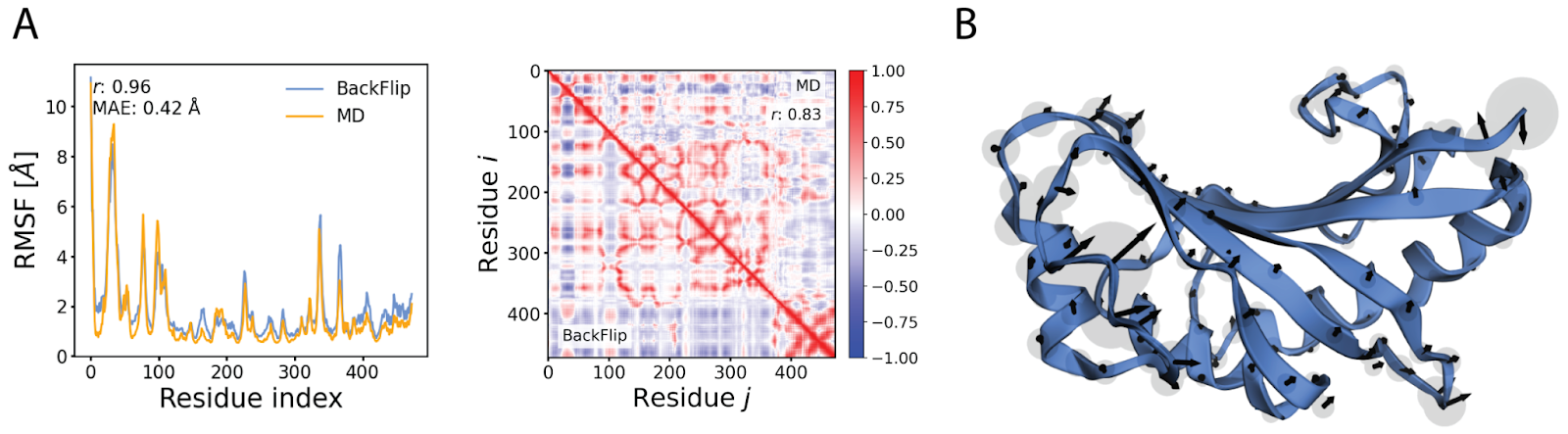
The same description of flexibility can be used in reverse, to design proteins that move in a prescribed way. Using flow matching and related generative approaches, we generate backbones conditioned on a target flexibility profile, and we are developing physically informed generative models in which energies and forces, rather than structural likelihood alone, guide the generative process. The goal is design that specifies not only what a protein looks like but how it behaves.
RNA structure and the role of ions
Deep-learning methods now predict RNA structure, but accuracy remains far below what is achieved for proteins. Our work has mapped where these methods fail, and two causes dominate. The first is homology: RNA alignments are shallow and must be built with secondary-structure-aware covariance models rather than the sequence-only searches used for proteins. The second is that RNA folding depends on ions, which current models largely ignore. We are addressing both, generating structural ensembles for the thousands of RNA families that have no experimentally resolved structure, and retraining all-atom models to account for ion-dependent structure, building on our work in CASP16 on blind prediction of water and ion ensembles around RNA.
AI and structural modelling of protein interactions
Proteins rarely act alone. A central goal in the lab is to predict how proteins recognize one another and how larger assemblies are built from pairwise and higher-order interactions. We develop methods that use AlphaFold-based modelling and related machine-learning strategies to predict protein-protein interactions and reconstruct large complexes. A particular focus is antibody-antigen recognition, where prediction remains markedly harder than for other complexes: we have built benchmarks that measure this gap honestly and develop methods that rank candidate binding modes to close it. Current work extends this toward proteome-scale interaction mapping and structural models of molecular systems in human cells.
Proteoforms and the molecular language of the cell
A gene does not produce a single invariant product. Splicing and post-translational modifications generate many proteoforms, and these different molecular states shape cellular function. In our current work, we combine long-read transcriptomics, proteomics, deep learning, and structural modelling to identify proteoforms, predict their interaction partners, and build atomistic models of the resulting complexes. The long-term goal is a more complete and mechanistic description of the human proteomic landscape.
Protein evolution and domain architecture
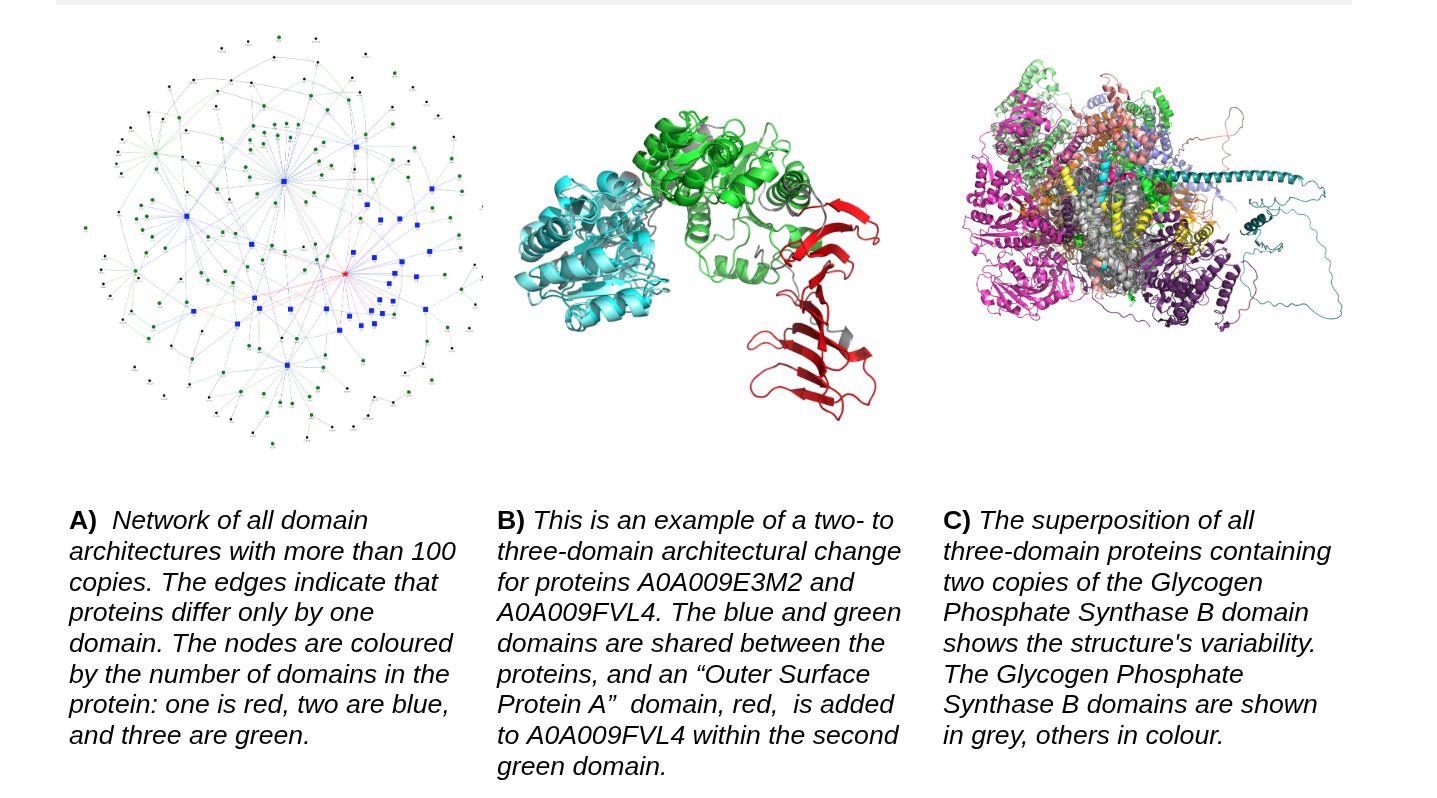
Proteins evolve under structural and functional constraints. We are interested in how domains change, how new multi-domain architectures arise, and how structural diversification shapes protein families across evolution. With modern resources such as AlphaFoldDB and TED, these questions can now be studied at a scale that was previously impossible.
Membrane proteins, from topology to whole membranes
The lab has a long-standing interest in membrane proteins and the sequence-structure principles that govern their insertion, topology, and folding. This includes prediction of transmembrane helices, topology constraints, and the structural organization of membrane proteins. We are now extending this from single proteins to membranes as a whole: within CEMERAI, a centre for modelling life at the membrane with AI, we combine structure prediction with coarse-grained and atomistic molecular dynamics, and with experimental constraints from proteomics, glycoproteomics, and lipidomics, to build multiscale models of how proteins, lipids, and glycans jointly organize a membrane.
Current funded work includes large collaborative efforts on proteoforms and molecular interactions, on modelling life at the membrane, and on protein domain architecture evolution. We are especially interested in problems where new computational ideas unlock previously inaccessible biology, and in building methods that are both accurate and interpretable so computational advances translate into mechanistic understanding.